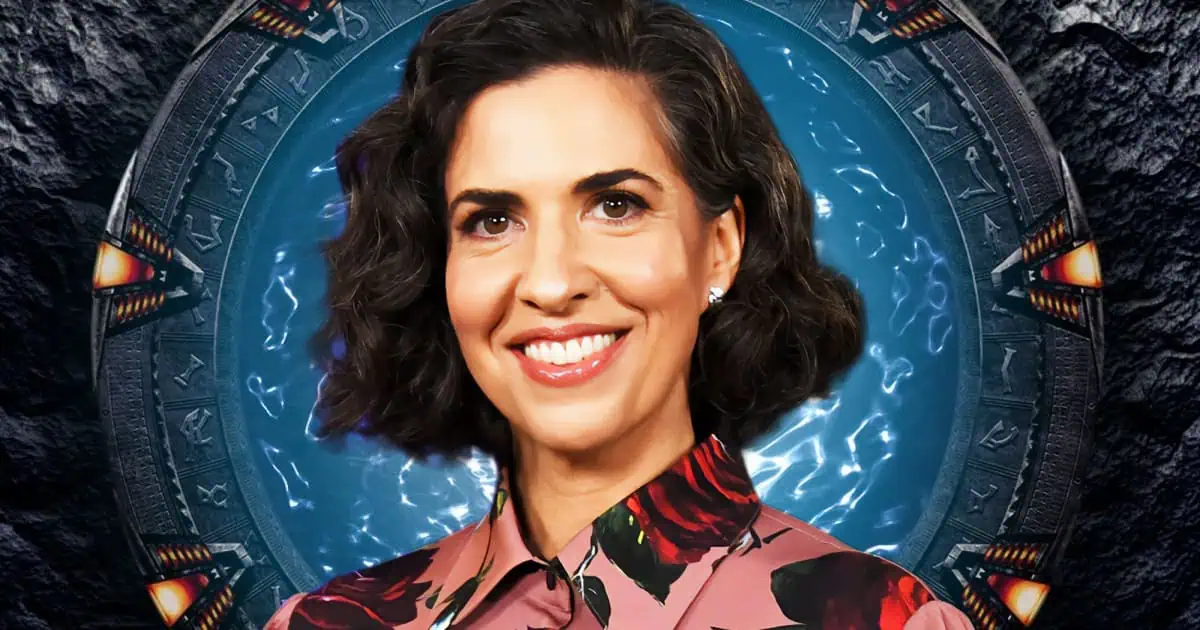
Dialing the Past: Why Jac Schaeffer’s Stargate Revival Is a High-Stakes Gamble for Amazon
If you take a step back and think about how intellectual properties are managed in modern Hollywood, the lifecycle of a sci-fi franchise starts to look less like an artistic journey and more like a corporate shell game. Every few years, a studio digs up an old sci-fi corpse, dusts it off, applies a fresh coat of high-budget paint, and hopes against hope that lightning strikes twice. What many people don't realize is how frequently these multi-million-dollar reboots happen behind closed doors before a single frame is ever shot. Now, Amazon MGM Studios is rolling the dice on the Stargate universe yet again, tapping WandaVision mastermind Jac Schaeffer to crack the code. Personally, I think this move tells us a lot about how major streamers view nostalgia—and why they are terrified of it.
The Trap of Niche Loyalty Versus Mass Appeal
A detail that I find especially interesting is the post-mortem of Amazon’s previous attempt to reboot the franchise. That cancelled version, helmed by franchise veteran Martin Gero alongside original architects, was apparently torpedoed because executives worried it lacked broad appeal beyond the hardcore fanbase. In my opinion, this reveals a classic Hollywood paradox: studios buy a beloved legacy property precisely because of its built-in fanbase, yet they panic the moment a pitch leans too heavily into pleasing those exact same fans.
What this really suggests is a deep-seated executive anxiety about alienating the mainstream viewer who can't tell a Goa'uld from a Go-Bot. If you build a show purely for the old-school devotees, you risk trapping it in a walled garden; if you water it down for the masses, you dilute the very flavor that made people care in the first place. Navigating that tightrope is brutal, and it's the exact trap that sank the last iteration before it even left dry dock.
Why Jac Schaeffer Is an Unconventional, Brilliant Choice
What makes this reboot fascinating is the hiring of Jac Schaeffer. If you look at her track record with WandaVision, her superpower isn't necessarily massive space-battle choreography or hard military sci-fi world-building; it’s subversion, character-driven mystery, and playing playfully with familiar structures. From my perspective, hiring Schaeffer means Amazon isn't just trying to make another generic military-portal shoot-em-up.
Instead, they are looking for someone who can inject emotional texture and structural cleverness into a premise that has historically relied heavily on monster-of-the-week formulas and serialized space opera tropes. One thing that immediately stands out about this choice is that it signals a pivot away from pure nostalgia toward a more distinctive creative voice. If Schaeffer brings even a fraction of the psychological acuity she showed in Westview to the Cheyenne Mountain complex, we are in for something entirely unexpected.
The Heavy Burden of Legacy and Fan Expectations
Let’s be honest: reviving a universe with the massive, multi-decade television footprint of SG-1, Atlantis, and Universe is a thankless task. Fans are fiercely protective, possessing an encyclopedic memory for canon continuity and character arcs. When rumors swirled that the previous iteration would feature Michael Shanks as an alternate-reality Daniel Jackson, the community rallied fiercely because it honored that lineage.
If you take a step back and analyze fan culture today, you realize they don't just want content—they want validation of their past devotion. When a studio hits the reset button and tosses out years of lore, it feels like a personal betrayal to the people who kept the brand alive during its darkest, quietest years. Schaeffer and her team are going to have to walk a razor-thin line: respecting the past while boldly carving out a future that doesn't feel like a museum piece.
The Bigger Picture for Modern Sci-Fi Television
This whole saga raises a deeper question about where franchise television is heading in the streaming era. We are living through an era of perpetual reinvention, where legacy catalogs are mined endlessly because original sci-fi world-building is an increasingly risky financial bet for studios. It is much easier to sell a title that has decades of brand recognition than to convince audiences to invest in a totally unknown universe.
Yet, relying purely on name recognition carries its own creative poison. If every sci-fi show has to be a broad, four-quadrant crowd-pleaser that alienates no one, we risk losing the sharp edges and niche brilliance that made speculative fiction great in the first place. Ultimately, I am cautiously optimistic. Schaeffer has proven she can turn genre tropes inside out, and Stargate has always been a concept with infinite structural flexibility. Whether Amazon will let her be weird enough to make it truly great, however, is a question only time—and the gate—will tell.